
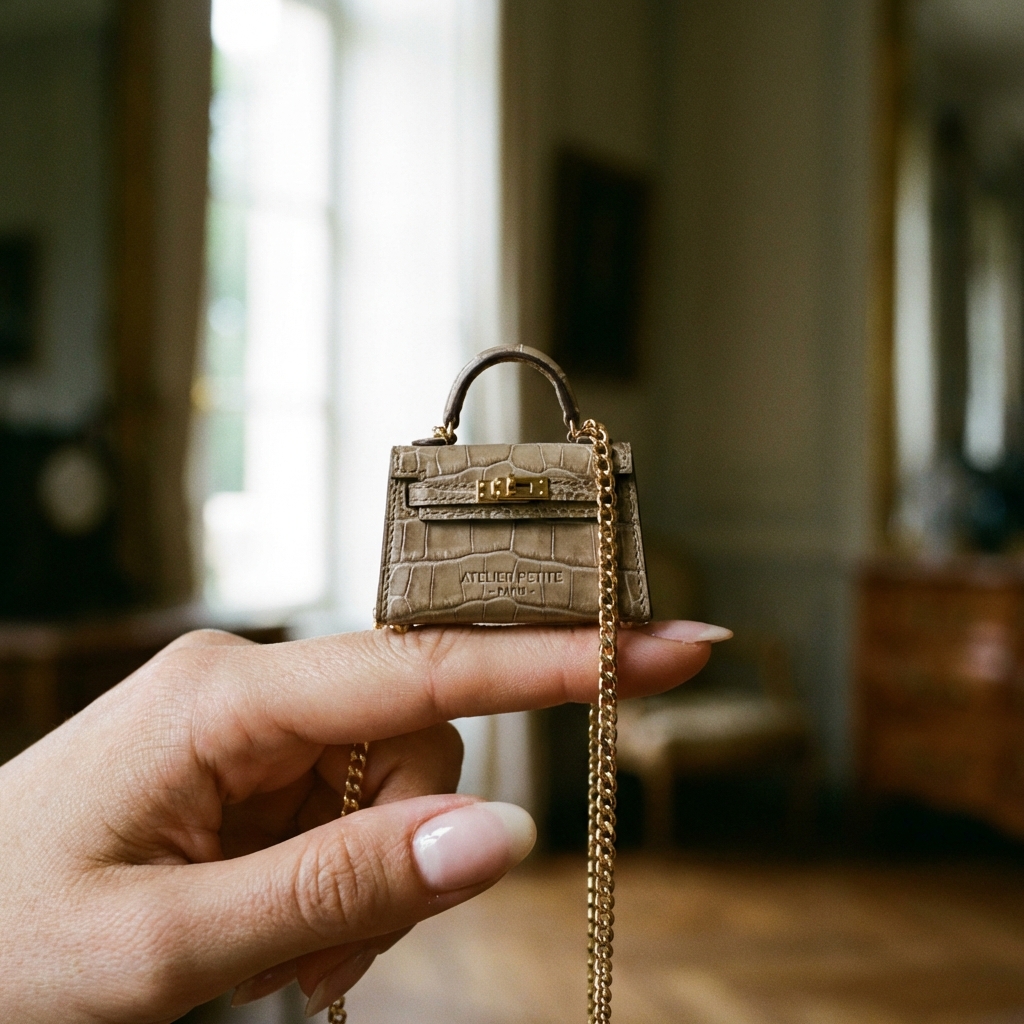
It shouldn't work. A bag that cannot hold a smartphone violates the primary rule of industrial design: function follows form. Yet, the "Mini Bag" has defied the odds, remaining a staple of luxury runways for nearly a decade. In 2026, we explore the deep psychological and market forces that have turned a logistical nightmare into a multi-billion dollar category of its own.
I. The Historical pivot: From Utility to Jewelry
To understand the mini bag, one must look back at the history of the reticule in the 18th century. When pockets were removed from women's garments in favor of the slim silhouettes of the Directoire period, the hand-held bag was born. It was never intended for survival—it was intended for a handkerchief, a coin, and perhaps a scent bottle. The modern mini bag resurgence is a deliberate return to this period of "ornamental utility."
The 2026 market has seen a complete decoupling of the "bag" from the "vessel." While the 1990s was the era of the 'It Bag' as a functional carryall, the current decade treats the bag as a sculptural appendage. We are witnessing the final stage of the bag's evolution into jewelry. A Jacquemus Le Chiquito or a Chanel Micro Flap is no longer competing with a backpack; it is competing with a Cartier bracelet.
II. The Psychology of Performance: Status in the Unburdened
Wearing a bag that fits nothing but a single AirPod and a credit card is a profound statement of socio-economic status. It signals that you don't *need* to carry anything. You have a driver, you have an assistant, or perhaps you are simply so unburdened by the requirements of the ordinary world that a smartphone is handled by someone else—or tucked into a hidden pocket of a tailored blazer.
It is the ultimate "Stealth Wealth" move—a rejection of utility in favor of pure iconography. In a world where we are increasingly weighed down by digital devices and the clutter of modern life, the mini bag represents a fantasy of minimalism. It is a controlled, curated rebellion against the "preparedness culture" of the 2010s.
III. Market Valuation: The Resale Paradox
One might assume that a bag with less material would have less resale value. Data from the 2025-2026 fiscal year suggests the opposite. On platforms like Rebag and Vestiaire Collective, mini bags from "The Big Three" (Hermès, Chanel, Louis Vuitton) are maintaining a higher retention of retail value—often exceeding 110% of their original price—compared to their larger counterparts.
2026 Resale Value Retention Index
- Hermès Kelly 20 (Mini) 165%
- Chanel Wallet on Chain (Nano) 98%
- Jacquemus Le Chiquito 74%
The lower entry price point (relatively speaking) for mini bags attracts a younger demographic of collectors, creating a high-velocity secondary market. For the investor, the "mini" is often a safer hedge than the "oversized," which is more susceptible to the whims of fashion cycles.
IV. The 2026 Transition: The Rise of "Mini-Plus"
As we enter the latter half of the decade, the industry is adjusting to what we call "The Functional Limit." Designers have recognized that even the most dedicated fashionistas are growing weary of holding their iPhones in their hands all night. This has given birth to the **"Mini-Plus"** silhouette.
This new category maintains the aesthetic proportions of a micro-bag but utilizes clever interior engineering—stretch gussets, magnetic dividers, and increased depth—to accommodate a pro-sized smartphone and a lipstick. It is the compromise that ensures the trend's longevity into 2027. We are seeing this masterfully executed in the new **Bottega Veneta Mini Sardine** and the **Loewe Nano Puzzle** updates.
V. Expert Forecast: A Permanent Category
Is the mini bag a fad? Our editorial verdict is a firm **No**. While the "ultra-micro" (bags smaller than 10cm) will return to the realms of high-fashion novelty, the 15-20cm "Mini" has officially earned its place as a permanent fourth category in the luxury handbag lexicon, alongside the Tote, the Shoulder Bag, and the Clutch.
Collectors should look for "Mini" versions of legacy icons. The **Kelly 20** and the **Lady Dior Micro** are no longer trends; they are blue-chip assets. As long as luxury fashion continues to intersect with the world of collectible art, the mini bag will remain the most accessible and visually arresting way to carry one's status.
When investing in a mini bag today, prioritize hardware quality. Since the bag itself is small, the eye naturally gravitates to the metalwork. Avoid "fast-fashion" micros with plastic plating; instead, look for palladium or 24k gold-hardened brass that can withstand the frequent handling of a hand-held piece.
Conclusion
The tiny revolution was a necessary disruption. It broke our dependency on "carrying everything" and forced us to consider the bag as a piece of art rather than a suitcase. As we move further into 2026, the mini bag remains the ultimate symbol of the modern woman: agile, unburdened, and undeniably chic.