
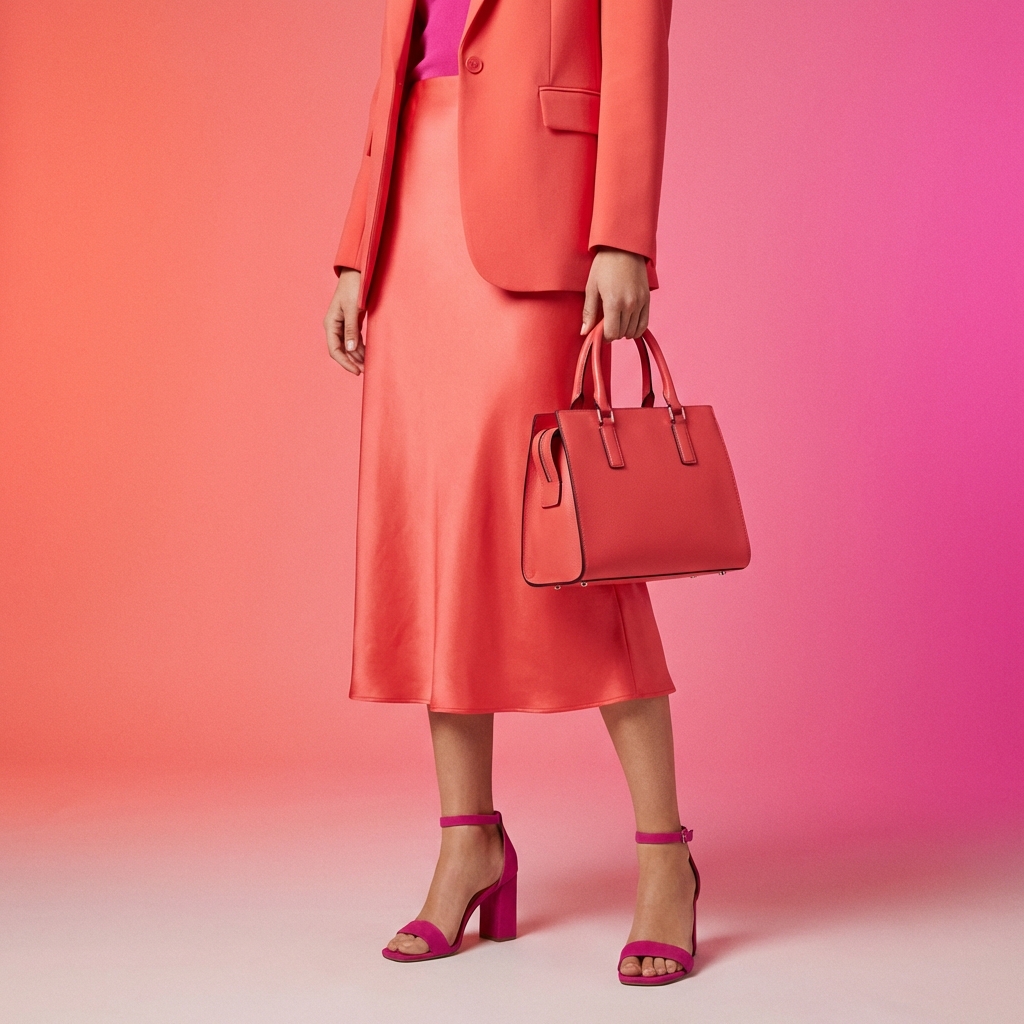
We’ve all heard the traditional mandate: "Your bag must match your shoes." This 1950s sartorial law was designed to create safety in an era of rigid etiquette. In 2026, safety is the antithesis of style. Modern color theory is about creating a dynamic conversation between your accessories, not a repetitive mirror image.
I. The Historical Anchor: Why We Matched
To break the rules of 2026, we must first understand the social engineering of 1955. Post-war fashion was an exercise in "Constructed Order." Matching your handbag to your pumps was a signal of economic stability—it meant you had the resources to purchase coordinated sets. It was a visual shorthand for "Everything is Under Control."
As we moved into the 2020s, this order began to feel "stiff." The modern woman’s life is multifaceted; her wardrobe should reflect that complexity. Today, exact matching is often perceived as a lack of creativity or, worse, an "AI-generated" approach to styling. In 2026, the goal is **Cohesion, not Conformation.**
II. The "Bridge" Strategy & The 60-30-10 Rule
If you aren't matching exactly, how do you prevent an outfit from looking like a collection of random accidents? We look to interior design for the **60-30-10 Rule**. In a perfectly balanced outfit, 60% is your primary color (usually the suit or dress), 30% is your secondary (the bag or outerwear), and 10% is your accent (shoes or jewelry).
The secret is the **"Bridge Accessory."** This is a third piece—perhaps a silk scarf, an enameled watch, or even the gradient in a pair of sunglasses—that contains both the color of your bag and your shoes. If you are wearing navy pumps and a cognac tote, a scarf with a navy-and-tan print acts as the "visual glue" that makes the combination look intentional. It tells the eye: "I chose these together."
III. The Physics of Refraction: Texture as Color
Color is not a static property; it is a result of light reflecting off a surface. This is why a "Black" bag and "Black" shoes rarely actually match. A matte **Saffiano leather** absorbs light, appearing "void-like," whereas a **Patent leather** pump reflects light, appearing almost grey or silver at the edges. In 2026, we lean into this dissonance.
When mixing textures, you can actually use the same color and still achieve a high-fashion look. Pair a velvet burgundy clutch with patent burgundy stilettos. The shift in texture creates "Visual Depth" that an exact material match lacks. This is particularly effective for evening wear, where artificial lighting highlights the contrast between the "soft" weave of fabric and the "sharp" shine of leather.
The 2026 Palette Harmony Guide
| The Duo | Vibe | Recommended Context |
|---|---|---|
| Chartreuse & Navy | The Corporate Rebel | Boardroom Meetings |
| Ochre & Burnt Tobacco | Heritage Luxe | Autumn Weekends |
| Lavender & Concrete Grey | Techno-Chic | Morning Gallery Visits |
IV. The Psychology of the "Pop"
For the ultra-minimalist, the "Matching" rule is replaced by the **"Single Focal Point"** strategy. If your entire outfit is monochromatic—say, an all-grey oversized Loro Piana set—your bag and shoes should not just "not match," they should compete for attention in a controlled way. Our styling data shows that a "Vibrant Bag" paired with a "Neutral Shoe" is perceived as more sophisticated than the reverse. A Kelly Green bag with nude pumps says "I am an expert in color." Kelly Green shoes with a black bag says "I am wearing an accessory."
V. Pro Tip: The Seasonal Correction
In 2026, seasonal colors are no longer dictated by the weather, but by **"Material Context."** In the Spring, we recommend the **Analogous Harmony**—colors that sit next to each other on the wheel (e.g., Pink and Red). It creates a soft, energetic flow. In the Winter, we move toward **Complementary Tensions** (e.g., Midnight Blue and Sun-washed Yellow). The goal is to use your accessories to provide the warmth or coolness that the ambient environment lacks.
The death of the "Exact Match" is the birth of personal agency. Don't look for shoes that match your bag; look for colors that tell the same story. In 2026, the most stylish woman is the one whose accessories look like they are in love, but not siblings.
Conclusion
Matching your accessories is a fallback, not a standard. By understanding the relationship between hues, light, and texture, you can move from "wearing an outfit" to "curating a presence." In the landscape of 2026, your bag and shoes are the bookends of your personal narrative—make sure they aren't the same chapter.