
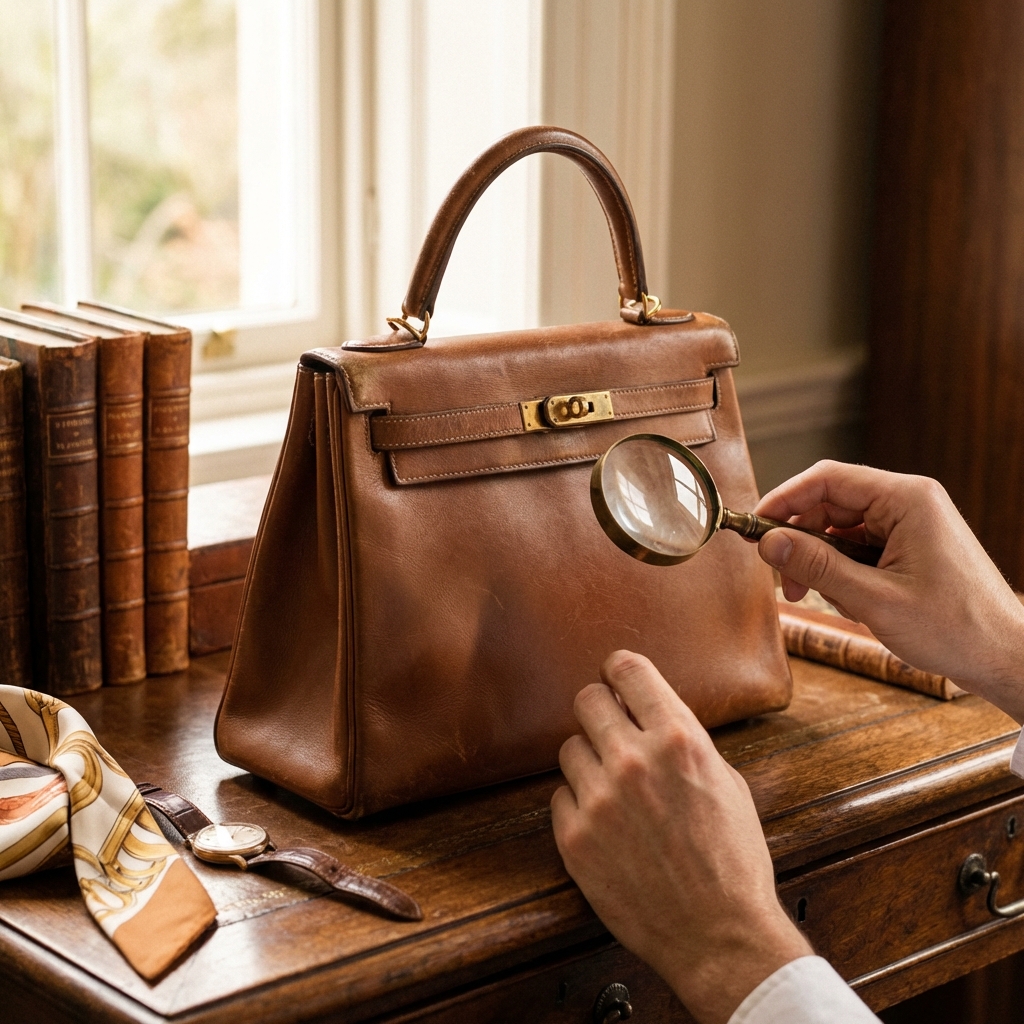
The creation of "Superfakes" has reached a terrifying level of industrial sophistication. In 2026, counterfeiters are using real leather from the same LVMH-owned tanneries as the brands, and even high-precision 3D printing for hardware. But there are still forensic signatures that the human hand cannot fake.
I. Forensic Stitching: The Saddle Stitch vs. The Machine
The most reliable indicator of an Hermès or a high-end vintage Chanel is the **Stitch Angle**. Hermès utilizes a traditional *saddle stitch* manual technique. Because the needle passes through the leather at an angle, the thread naturally sits in a slight diagonal (slanted) orientation. More importantly, when a human pulls a thread, they do so with varying tension. A microscopic inspection will reveal tiny, organic variations in depth.
Superfakes utilize sophisticated sewing machines that mimic the slant. However, a machine's tension is uniform. If your stitches are perfectly straight or perfectly identical under a 10x jeweler’s loupe, the bag was likely mass-produced. For Chanel, count the **Stitches Per Inch (SPI)**. A vintage Medium Flap must have at least 10-12 SPI. Counterfeiters often drop to 8 SPI to save on production time, resulting in a quilt that looks "spaced out" and lacks the iconic puffiness.
II. Hardware Metallurgy: The Weight of Heritage
In 2026, counterfeiters have mastered the *look* of gold, but they struggle with the *metallurgy*. Authentic vintage Chanel (pre-2008) utilized **24k gold plating** on brass. This creates a deep, rich yellow tone that glows rather than shines. Modern Superfakes often use a "flash plating" of 14k or 18k gold over zinc or aluminum. The result is a bag that feels "top-heavy" but has "featherweight" hardware components.
Test the **Zip Action**. High-end houses use precision zippers from Riri, Lampo, or the prestige lines of YKK. The movement should be "gritty" but smooth—a paradox of engineering. If a zipper feels like it's sliding on ice, it's likely a cheap modern component. Additionally, inspect the back of the slider. Authentic sliders are debossed with the brand logo with surgical precision; fakes often show "soft edges" where the metal was cast rather than stamped.
III. The Olfactory Anchor: The Scent of Authenticity
It sounds primitive, but the "Smell Test" remains a powerful diagnostic tool for experienced authenticators. Authentic luxury leather smells of Earth, tannins, and wood—a result of the months-long vegetable tanning process. Superfakes, despite using high-quality hides, often have a faint chemical or "glue" scent. This is a byproduct of the industrial adhesives used to bond the lining to the exterior—a step that heritage maisons perform with hand-stitched reinforcement rather than chemical bonding agents.
The 2026 Red Flag List
- ❌ The Plastic Glaze: If the "edges" of the straps look like they are coated in thick plastic (edge-paint), it's a fake. Brands use thin, translucent layers.
- ❌ Magnetic Logic: Most luxury magnets are heavy and have a low-pitch "clack." Cheap magnets are light and high-pitched.
- ❌ Typographic Errors: Look at the "E" in Chanel. The bottom bar must be slightly longer than the top. Scammers often use a generic font.
IV. The Rise of the Digital Twin (2025-2026)
The biggest disruption in 2026 authentication is the **NFC Digital Passport**. Brands like Louis Vuitton and Dior have moved away from physical authenticity cards in favor of microchips embedded deep within the lining. However, counterfeiters have responded by cloning these chips.
The solution is **Blockchain Verification**. An authentic bag in 2026 is registered on a private ledger. When you "scan" the bag, it doesn't just show a serial number; it shows the transaction history of that specific unit. If you are buying a bag produced after 2024, do not accept it without a verified Digital Twin transfer. Systems like **LVMH’s Aura Blockchain** are the only foolproof way to guarantee provenance in the age of the Superfake.
V. Pro Strategy: The Jeweler’s Loupe Inspection
When you are committing $5,000+ to a vintage find, you must look at the **Lining Attachment**. In authentic bags, the lining is "turned" and stitched into the frame. In fakes, you will often find remnants of heat-sealing or glue at the base of the interior pocket. Turn the bag inside out if possible—the world's best counterfeiters spend 90% of their budget on the exterior and 10% on the interior mechanics. The truth is found in the dark corners of the bag.
In 2026, we no longer recommend peer-to-peer marketplaces without a middleman. Use platforms like **Fashionphile** or **Rebag** who provide a lifetime authenticity guarantee. The cost of their commission is the price of your peace of mind.
Conclusion
Authentication is a battle between the artisan and the machine. As technology makes fakes more beautiful, we must return to the basics: the weight, the smell, and the tiny imperfections of a human hand. In the world of luxury, the truth is always in the details that are too expensive for a factory to reproduce.